
The Transition Barrier: Why Crossing Into a New Field Feels Impossible — and What Actually Works
Why changing professions feels impossible: the cognitive traps, the invisible social wall, and the researched ways through — from someone going through a second career change right now.
Two weeks ago I published my first podcast episode, my first videos, and a course on my website. Once again, I have no idea what I’m doing. Where to start, what to do, what not to do — all of it is fog.
The strange thing is, I’ve been here before. Years ago I decided to become a programmer, and it was brutally hard: closing the gaps, assembling scattered information into a single puzzle, building the environment that eventually carried me to the finish line. I felt like an impostor the whole way. I still do. And now, stepping into blogging and content, I’m a blind kitten all over again.
So this time I decided to do something different: instead of just suffering through the transition, I studied it. It turns out the barrier between “where I am” and “where I want to be” has been researched for fifty years. It has names, mechanisms, and — most importantly — known ways through.
This post is the map I wish someone had handed me the first time. And it’s the reason my blog exists: not to show how great the finish line looks, but how hard the road actually is — and that it’s walkable.
There is a checklist at the end
All of this ends in one checklist: a page of things you can actually do, in the order that matters. If you want it on paper, download the printable version.
Everyone lives in a bubble
Here’s the core observation everything else hangs on. Every person lives and works inside their own environment — a vacuum. From the inside, everything looks simple and obvious. The trouble starts the moment you try to cross from one bubble into another: a new profession, a new community, a new craft.
And right at the border, you hit three kinds of resistance at once:
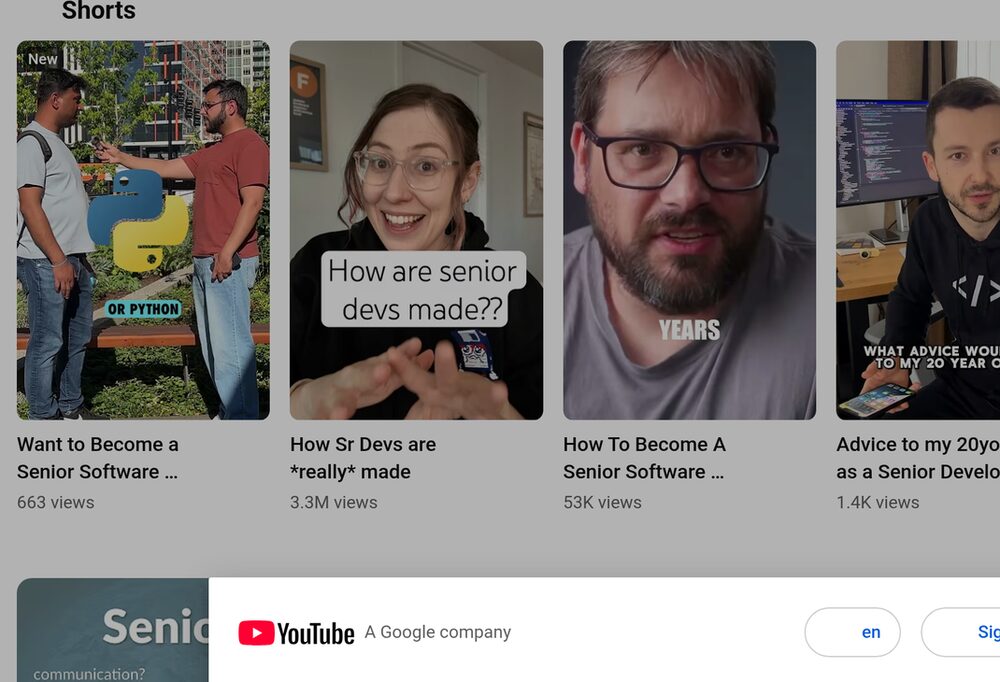
- Noise. Courses, blogs about fast success, AI tools, ads — everything screams that it’s easy. So when you finish a course and reality doesn’t cooperate, you don’t blame the course. You conclude you’re a failure, and you quit.
- Competition and closed doors. The field is full of brilliant programmers, bloggers, founders — and their communities are closed clubs. You arrive like a blind kitten, and you’re burning with shame.
- Experts who forgot. People with experience speak from the height of their current state. They genuinely cannot remember what it was like to know nothing.
None of this is personal. It’s structural. Let’s take it apart.
Part 1: The cognitive challenges — traps inside your own head
The illusion that it’s easy
Three separate effects conspire to make a hard road look flat.
Filter Bubble (Eli Pariser, 2011). The moment you show interest in a new field, algorithms flood your feed with success stories: “How I became a senior at 20”, “I built a startup in a weekend with AI”. What the algorithms don’t show you is the millions of people grinding through bugs for months, stuck in the valley of despair, or quietly quitting halfway. Success sells; slow routine doesn’t. You end up watching a victory exhibition and assuming the whole street looks like the shop window.

False Consensus Effect (Lee Ross, 1977). We extrapolate our own experience onto everyone else. This cuts both ways. Experts think: “Design patterns? That’s basic, everyone knows that.” Newcomers think: “Everyone around me seems to find this easy. If it’s hard for me, something is wrong with me.” Both are wrong, and both are the same bug.
Illusion of Competence (Barbara Oakley). Your brain confuses recognition with ability. Watching a tutorial and nodding along is cheap — the logic is right there on the screen. Producing the same thing from an empty file is a completely different cognitive act. Modern courses are engineered to never make you uncomfortable (uncomfortable students ask for refunds), and AI autocomplete lets your brain swap the hard work of generating for the easy pleasure of recognizing. You finish the course feeling like a programmer. You are, at that point, a very well-trained spectator.
The crash
Then reality arrives, and the Dunning–Kruger curve describes exactly what happens next:
- Mount Stupid. You’ve done a course and a few tutorials. Confidence is at its peak; actual knowledge is near zero. This is where the illusion of competence lives.
- The Valley of Despair. You open an empty editor for a real, non-templated task — and the illusion shatters. Confidence craters. This is where impostor syndrome, shame, and the urge to quit are born. Most people quit here.
- The Slope of Enlightenment. If you keep going, slow systematic progress begins. You stop expecting quick wins and start closing real gaps.
- The Plateau of Sustainability. Confidence finally matches competence.
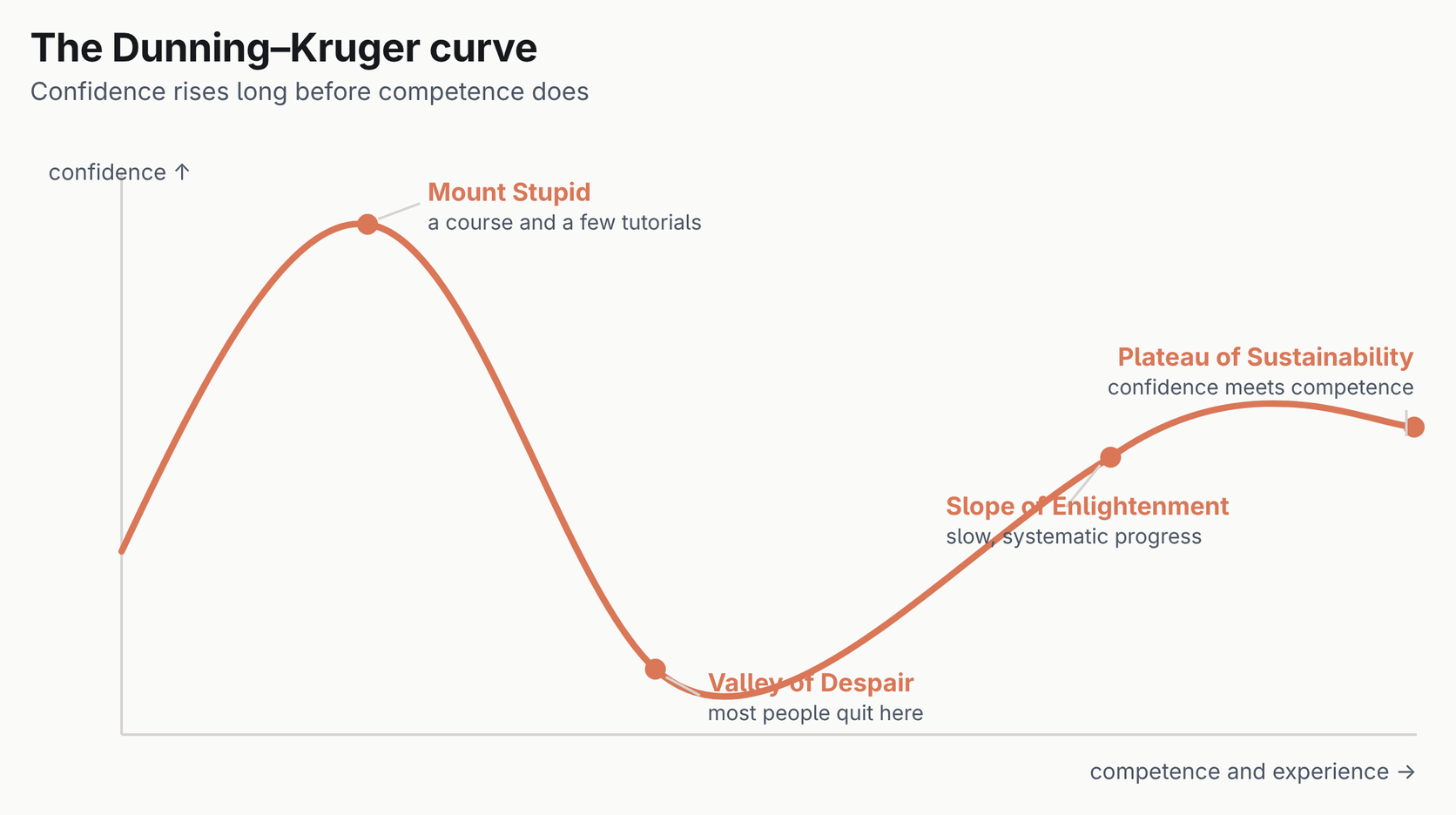
Here’s the reframe that kept me going: falling into the Valley of Despair is a good sign. It means your brain has dropped its illusions and seen the real size of the discipline. It’s the only place where the road to actual mastery begins.
The impostor at the border
Impostor Syndrome (term coined by psychologists Pauline Clance and Suzanne Imes, 1978) is the inability to internalize your own success — every achievement gets explained away as luck, timing, or trickery. Its core mechanic: you compare your backstage with everyone else’s stage. You know your 2 a.m. dead-ends, your twenty embarrassing Google searches, your hour lost to a missing semicolon. From others you see only the edited final cut.
But notice the paradox: real dilettantes rarely suffer from impostor syndrome — they’re busy sitting on Mount Stupid. If you feel like a fraud, it means two things: your critical thinking is developed enough to see the true scale of the field, and you’re standing exactly at the edge of your current ability — which is the only place learning happens. Impostor syndrome is the entry fee for new territory. If you’re not scared and everything is clear, you’re just sitting in your old aquarium.
Why experts can’t save you
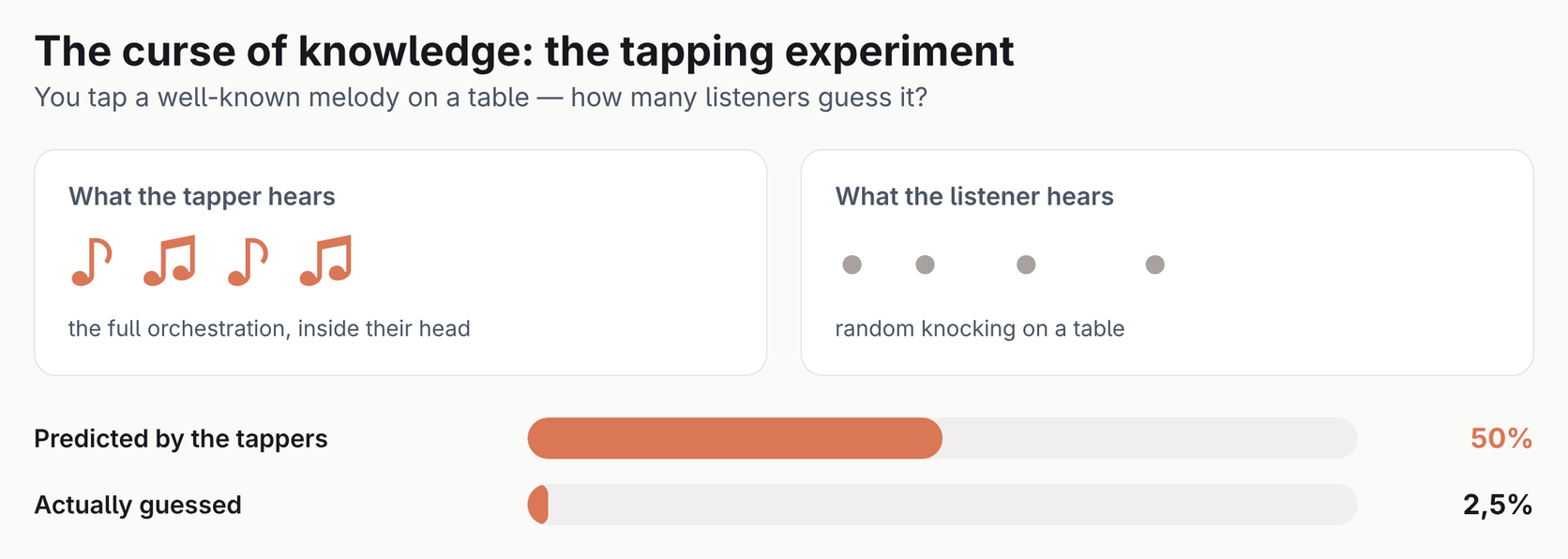
The Curse of Knowledge. In 1990, Stanford researcher Elizabeth Newton ran a famous experiment. “Tappers” were given well-known songs like Happy Birthday and asked to tap the rhythm on a table. They predicted listeners would guess the song 50% of the time. The actual result: 2.5%. The tapper hears the full orchestration in their head and physically cannot imagine hearing anything else. The listener hears random knocking.
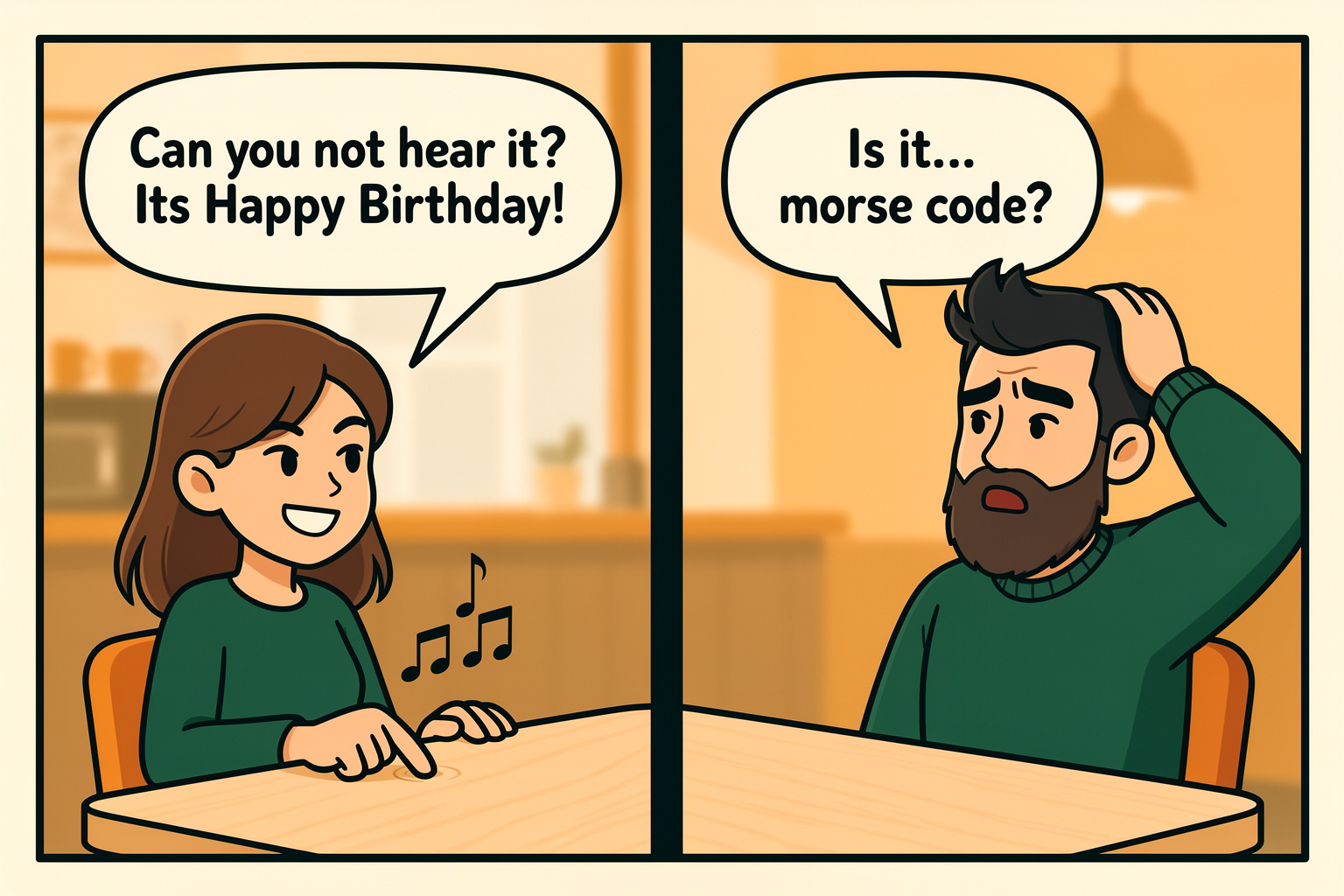
That’s your favorite senior engineer, course author, or tech blogger. Their brain has archived the beginner steps into automatic patterns; they transmit their current state, not the process that got them there. When an expert explains badly, it’s not because you’re stupid. It’s because their brain has been deformed by experience — literally.
Why you get stuck
The Einstellung Effect. Once your brain has laid down rails — a familiar pattern, a habitual solution — it sends every new problem down the old track. You bang your head against a wall for five hours not because you’re slow, but because your thinking is locked in a template.
Oakley’s explanation: the brain has a focused mode (narrow beam, runs on existing neural circuits) and a diffuse mode (background, panoramic attention that switches on when you walk, shower, or sleep). Every programmer knows this: five hours on a bug, nothing; then the answer detonates in your head in the shower. Focused mode collects the pieces; diffuse mode assembles the puzzle. This is also why a new profession can’t be crammed — neural connections need literal time and sleep to consolidate.
Part 2: The social challenges — the invisible wall
Cognitive traps explain why the learning is hard. They don’t explain why the community feels like a glass wall. For that, you need sociology.
You can’t storm a closed club (Pierre Bourdieu)
Bourdieu showed that status in any field runs on three forms of capital: cultural (knowledge, slang, unwritten rules, “taste”), social (your network of connections), and symbolic (reputation and recognition). On top of that sits your habitus — the autopilot of manners and reflexes formed by your past. The newcomer’s conflict: the habitus that made you competent in your old world instantly marks you as an outsider in the new one.
Gatekeeping is rarely explicit. Nobody says “we won’t accept you without a diploma.” It works through the unwritten code: how you ask questions in Slack, whether you use the slang correctly, whether you know the local memes and etiquette. Stumble over these invisible rules and the community answers with coldness or irony — and you conclude “they’re the elite, I’m nobody.”
Wrong conclusion. Communities don’t protect their borders with fences; they protect them with language. The shame of the blind kitten isn’t your stupidity — it’s friction between your old habitus and the new field’s rules. You’re trying to play chess by checkers rules.
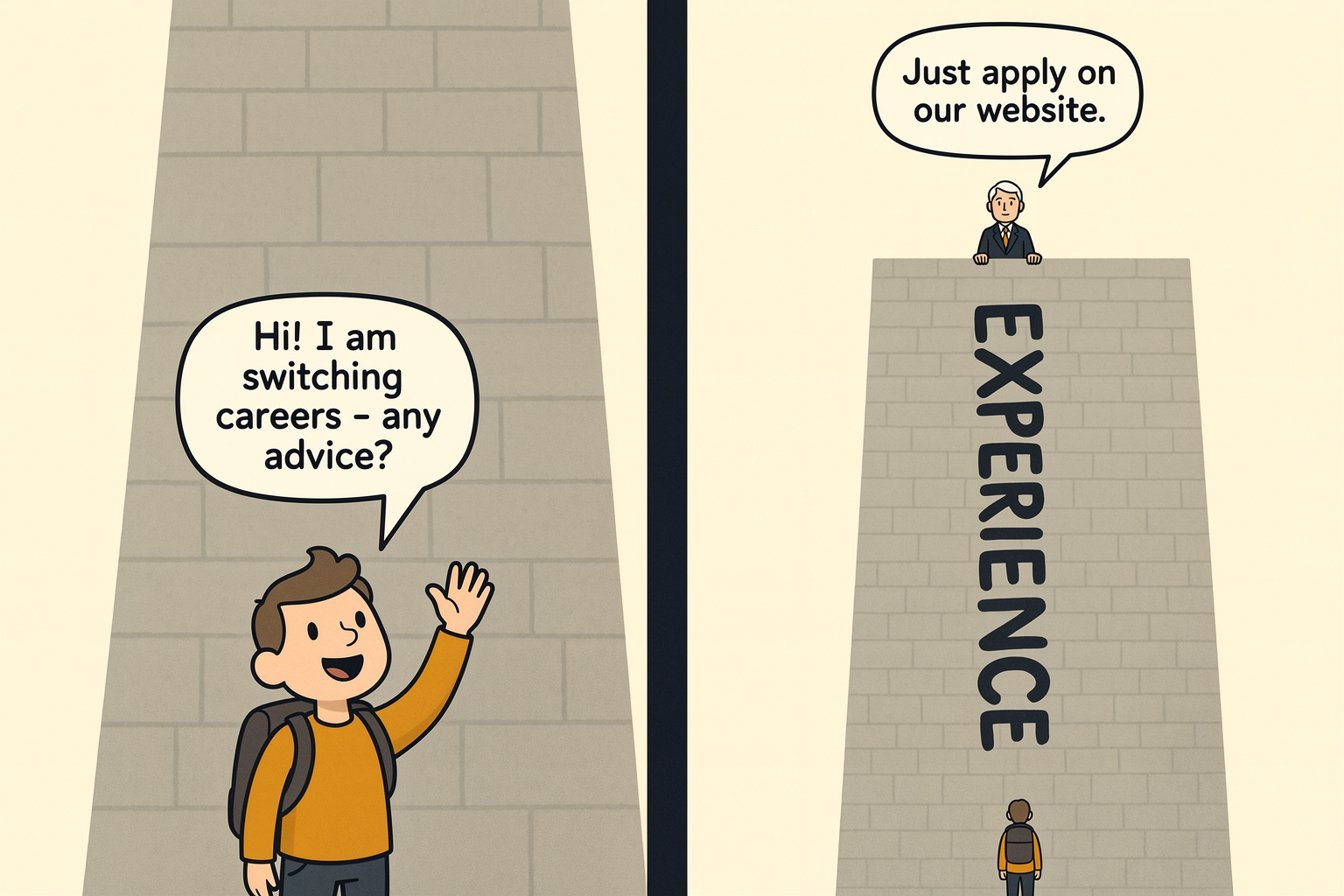
Bourdieu’s framework also maps the three ways in: storm the gate head-on with sheer persistence; convert capital from your old field (arrive as “the marketer who codes”, not as one more junior); or build horizontal ties in adjacent, non-elite communities and grow your own social capital from zero.
The side door is stronger than the front gate (Mark Granovetter)
In 1973, Granovetter published The Strength of Weak Ties and gave a scientific answer to “how do you get in when the doors are closed?”
Your strong ties — family, close friends, current colleagues — live in the same bubble as you. They know what you know. Your weak ties — acquaintances, ex-classmates, people from meetups, that person you talked to twice — are bridges into other social worlds. His finding: most people find jobs, partners, and rare opportunities through weak ties, not close friends.
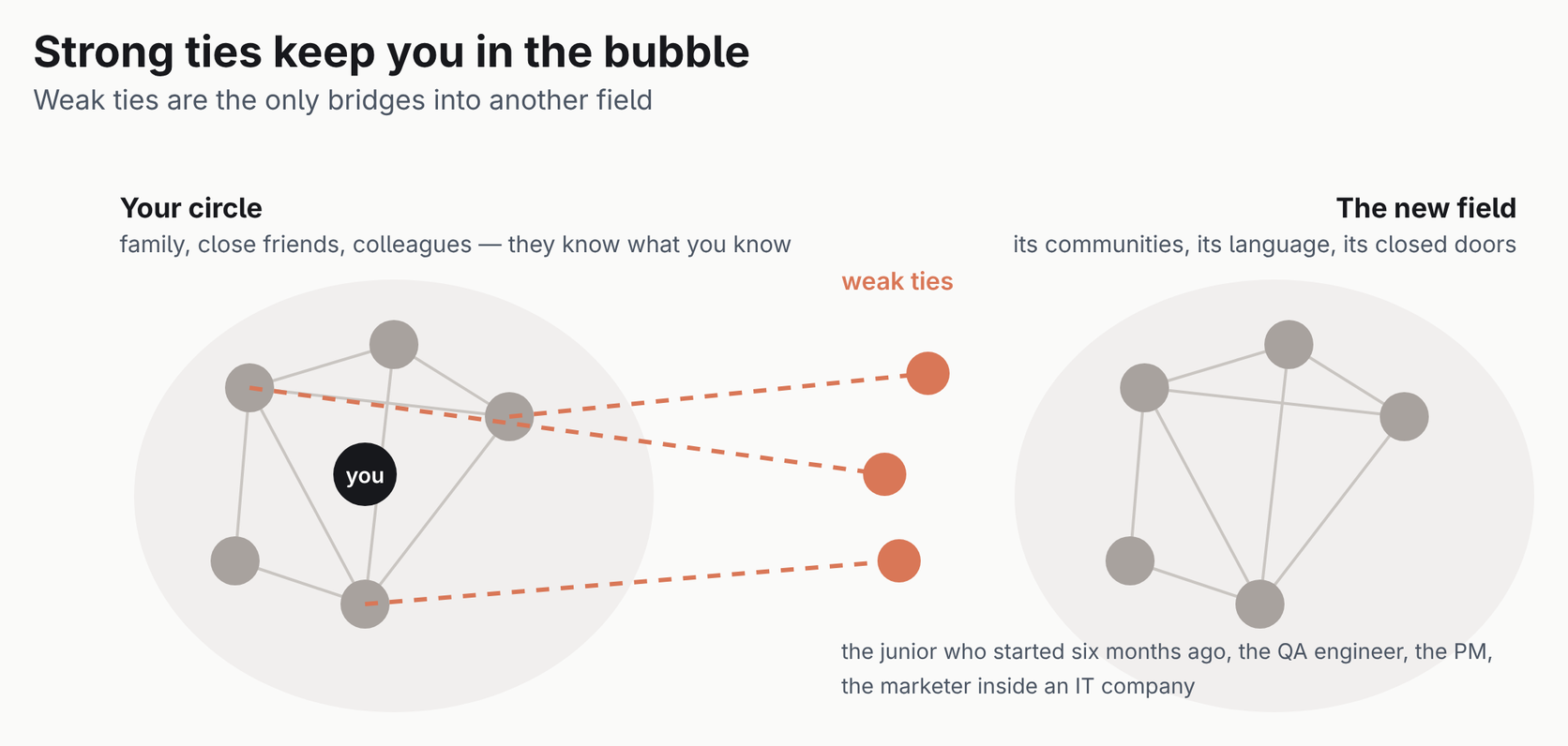
So don’t try to break down the elite’s front door. Look for the people sitting on the fence between your world and theirs: the junior who started six months ago, the QA engineer, the PM, the marketer inside an IT company. With them there’s no gatekeeping and no shame — you’re not begging for entry into a club, you’re just genuinely curious. And breakthroughs happen exactly at these intersections: coming from finance into code, you’re not “a zero in IT” — you’re an expert in the rare combination of finance and code, a combination no standard job posting filters for.
Your old circle will mock you first (the crab bucket)
The hardest shame isn’t in front of strangers — it’s in front of your old friends. When you start posting, recording, learning publicly, you break the unspoken social contract of your circle. Your growth subconsciously highlights their stagnation, and their jokes are an attempt to pull you back into the bucket: be like us, it’s safer.
Robert Cialdini named both halves of this movie. CORFing (Cutting Off Reflected Failure): while you stumble, people distance themselves — “I’m not with him, I also see it’s nonsense.” BIRGing (Basking in Reflected Glory): the moment you break through, the same people switch to “I’ve known him for ten years! Always believed in him!”
Schopenhauer described the full arc: first ridicule, then resistance, then acceptance as obvious. The mechanism that moves your circle through these stages is boring and unstoppable: regularity. Laughter dies where consistency appears. The shame of being mocked is temporary — it’s just the period while your environment updates to your new version. Step over it.
What this research actually changed for me
Before this digging, my second transition felt like a personal defect: everyone else glides, I crawl. Now the same experience reads completely differently:
- The confusion at the start isn’t weakness — it’s my brain demolishing a safe old map of the world and building a new one. That process is supposed to feel like stress.
- The shame isn’t mine — it’s gatekeeping, the crab bucket, and the false-consensus machinery running exactly as documented.
- The dead-ends aren’t proof I’m not cut out for this — they’re the Valley of Despair, the one predictable place where everyone wants to quit, which means it’s survivable by design.
Two weeks ago I was in a procrastination loop. Now I’m out of it and moving. There are plenty of challenges ahead, but many problems are already solved — I’m motivated and, more importantly, I’m armed. And the main thing: I actually like this path. I haven’t felt that in a long time.
The solution: cross the chasm with a beachhead
One framework ties the strategy together — Geoffrey Moore’s Crossing the Chasm, originally about tech products, and uncomfortably accurate about people.
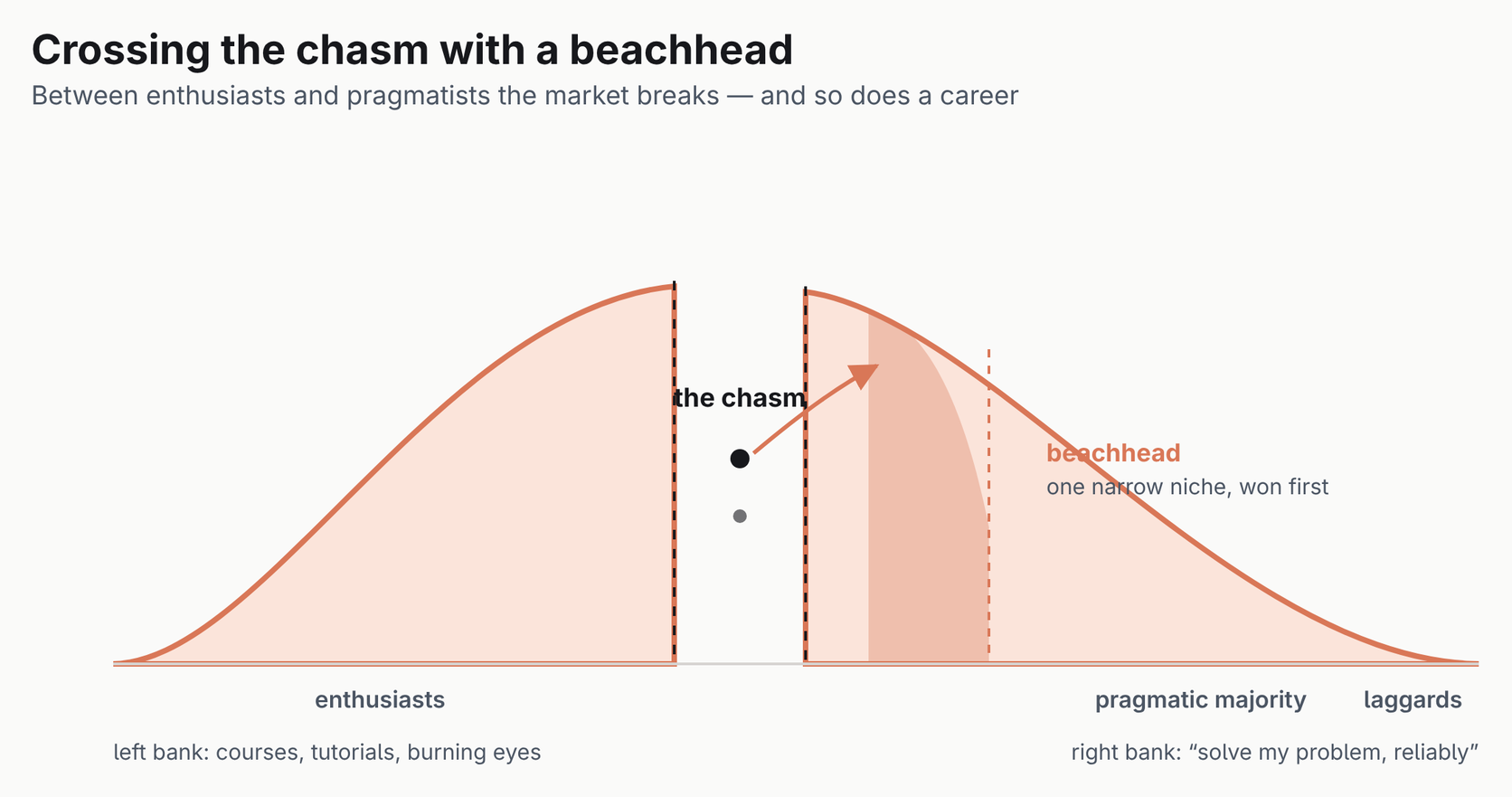
Moore showed that between early enthusiasts and the pragmatic majority yawns a chasm where 90% of products die. In a career transition, the chasm is the gap between student and professional. On the left bank you’re on fire: courses, tutorials, console scripts. On the right bank sit employers and clients — pragmatists who don’t care how many courses you finished or how brightly your eyes burn. They need their specific problem solved, reliably, without surprises.
People fall into the chasm because they attack it with student tools: one more course, a bit of everything, an attempt to appeal to the whole market at once. Moore’s answer is the beachhead strategy: don’t try to take the whole continent. Pick one tiny strip of beach, concentrate 100% of your force there, win there, then expand.
In practice: not “junior Python developer” but “the person who automates Telegram bots for local businesses”. Not another tutorial todo-list, but one real tool, for one real niche, finished end to end — code, tests, docs, deployment. Stop selling your enthusiasm. Start selling reliability.
The checklist: how to actually survive the transition
Everything above, compressed into what to do:
Fix the information diet
- Unfollow toxic “success porn” accounts; look for honest stories with timelines, dead-ends, and real durations
- Remember survivorship bias: every visible winner stands on a thousand quiet grinders
Fix how you learn
- After every page or video: close it and reproduce the key ideas from memory (recall beats recognition)
- Start building before you feel ready — the illusion of competence guarantees you’ll never feel ready
- If a hint, a tutorial, or ChatGPT solved the task, the task is not solved — redo a similar one cold, two hours later
- Work in focused sprints, then fully disconnect (walk, shower — no phone): that’s when the puzzle assembles
- Budget real time and sleep for consolidation; a profession doesn’t compile in a day
Fix the shame
- Reframe impostor syndrome as the entry fee: feeling like a fraud = you’re at the edge of your growth
- When an expert explains badly, blame the curse of knowledge, not yourself
- Treat mockery from your old circle as stage one of three — answer it with regularity, not arguments
Fix the social game
- Lurk first: learn the community’s language, norms, and unwritten rules before knocking (cultural capital precedes social capital)
- Don’t take gatekeeping personally — it’s systemic border protection, not a verdict on you
- Invest in weak ties: comment on others’ projects, ask polite questions in public threads, thank authors of useful posts
- Look for guides at “junior + 6 months” level and people in adjacent roles — they remember the way through the swamp
- Tell your circle what you’re learning; weak ties fire when someone says “my ex-colleague is looking for exactly that”
Fix the strategy
- Pick one narrow beachhead — a niche where your old background is an unfair advantage
- Ship one whole product: real problem, finished end to end, deployed, documented
- Measure progress in solved problems, not watched lectures
Resources
Everything in this post is built on these sources — start anywhere:
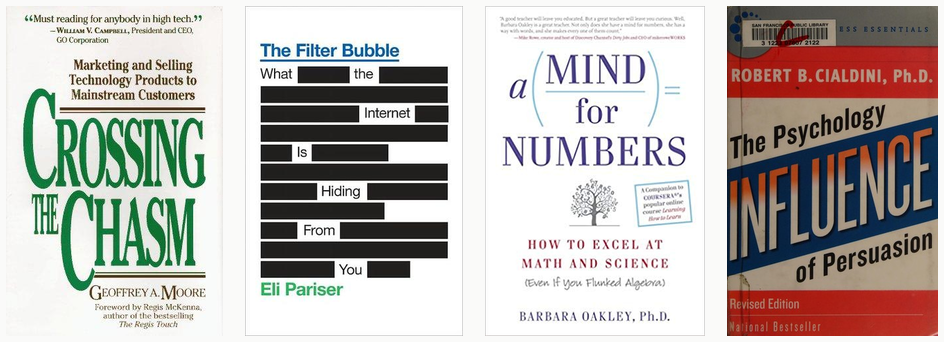
- Barbara Oakley — A Mind for Numbers / Learning How to Learn. Illusion of competence, focused vs. diffuse mode, the Einstellung effect, recall practice.
- David Dunning & Justin Kruger — “Unskilled and Unaware of It” (1999). The original study behind the curve: Mount Stupid to the Valley of Despair.
- Pauline Clance & Suzanne Imes — “The Impostor Phenomenon in High Achieving Women” (1978). Where the term impostor syndrome comes from.
- Eli Pariser — The Filter Bubble (2011). How algorithms turn your feed into an echo chamber of success stories.
- Lee Ross — “The False Consensus Effect” (1977). Why everyone thinks everyone else thinks like them.
- Elizabeth Newton — Stanford tapping study (1990) — the experimental demonstration of the curse of knowledge; popularized in Chip & Dan Heath’s Made to Stick.
- Pierre Bourdieu — “The Forms of Capital” (1986) and Distinction. Cultural, social, and symbolic capital; habitus; why fields defend their borders.
- Mark Granovetter — “The Strength of Weak Ties” (1973). Why acquaintances open more doors than close friends.
- Robert Cialdini — Influence. BIRGing and CORFing: why your circle mocks you now and claims you later.
- Geoffrey Moore — Crossing the Chasm (1991). The chasm between enthusiasts and pragmatists, and the beachhead strategy for crossing it.